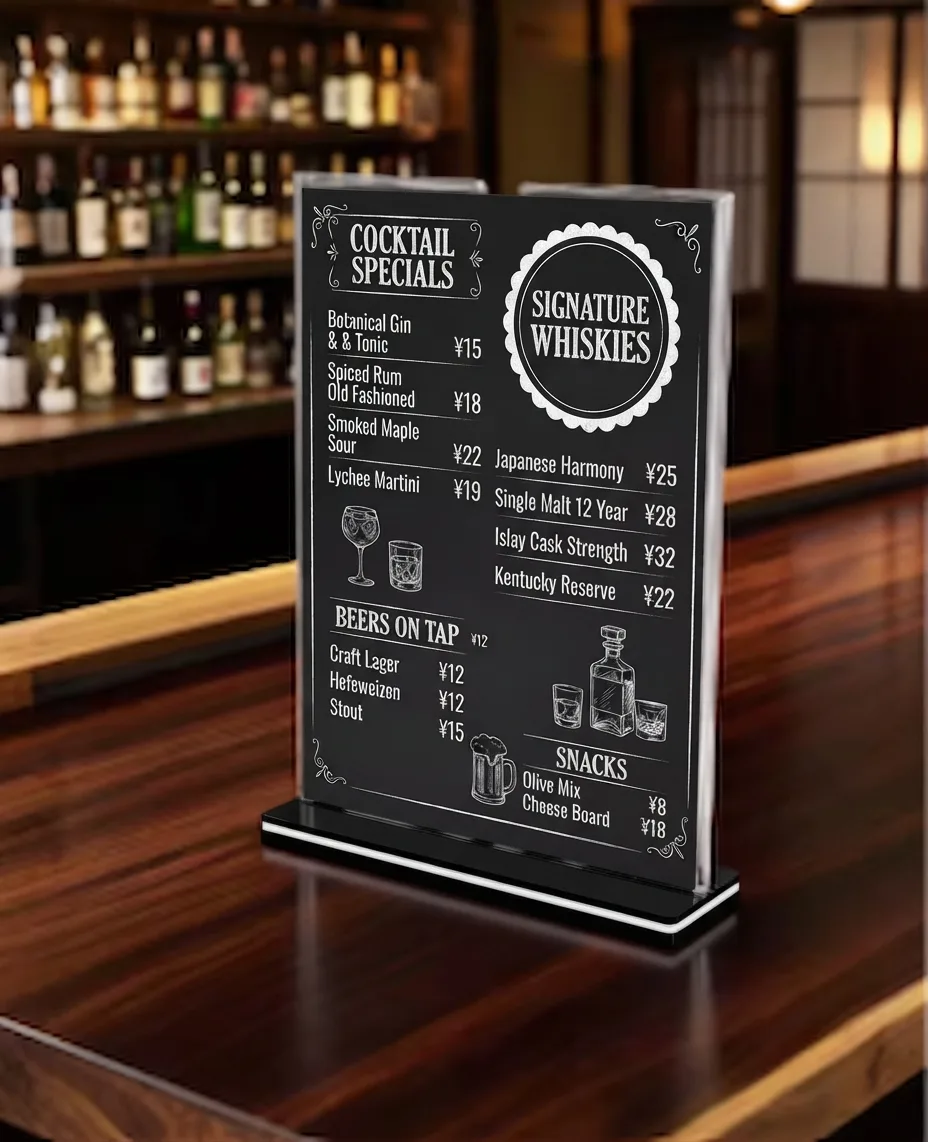
Acrylic Menu Holder — A4 Double Sided
$24.00
Free US shipping on orders over $150
Shop everythingHandmade in our own workshop · Shipped worldwide
Menu holders, counter signs, nameplates and poster stands — cut and polished in-house.
$24.00
$42.00
$46.00
$50.00
$300.00
$395.00
Not quite it?
Your words, your font, your colour — priced live and proofed before we build.
Start designing →No signs match those filters. and start again.
Acrylic is the default for anything that has to look considered without drawing attention to itself — a table menu, a counter notice, an office nameplate. It cuts cleanly, polishes to a glass-like edge, and costs a fraction of the glass it imitates while weighing a third as much.
The quality difference between a good acrylic stand and a bad one is almost entirely in the edges. A saw-cut edge is cloudy and slightly rough; a flame-polished or diamond-polished edge is transparent and sharp. It is the detail people register without naming, and it is the reason a cheap holder looks cheap from two feet away even when the material is identical.
We cut on our own laser and router, which means non-standard sizes cost a setup rather than a tooling charge, and a bespoke holder for an odd-sized card is a normal request rather than a special one.
Flame or diamond polished as standard. It is the difference people see without being able to name.
Clear disappears, frosted hides fingerprints, brushed metal-effect suits a reception wall.
Cut in-house, so an odd-sized holder is a setup charge rather than a tooling conversation.
Direct print for colour, laser engraving for something that will not wear off a nameplate.
Not sure which is right? Ask us — we will tell you if the cheaper option is the better one for what you are doing.